What is Artificial Intelligence?
Artificial Intelligence (AI) is a branch of computer science dedicated to creating systems capable of performing tasks that typically require human intelligence. These tasks include understanding natural language, recognizing patterns, making decisions, and learning from experience.
The concept of AI has evolved dramatically since its inception. What began as a theoretical pursuit in the 1950s has become one of the most transformative technologies of the 21st century, reshaping industries from healthcare to education, finance to entertainment.
A Brief History of AI
| Era | Milestone | Significance |
|---|---|---|
| 1950 | Turing Test proposed | Alan Turing defined the benchmark for machine intelligence |
| 1956 | Dartmouth Conference | The term "Artificial Intelligence" was coined |
| 1966 | ELIZA chatbot | First natural language processing program |
| 1997 | Deep Blue beats Kasparov | AI defeats world chess champion |
| 2011 | IBM Watson wins Jeopardy! | AI demonstrates natural language understanding |
| 2016 | AlphaGo beats Lee Sedol | Deep learning conquers the ancient game of Go |
| 2022-2024 | ChatGPT, Claude, Gemini | Large Language Models become mainstream tools |
| 2025-2026 | Agentic AI and Multimodal Models | AI systems that can reason, plan, and use tools autonomously |
Why AI Matters Now
Three converging factors have made AI more powerful and accessible than ever before:
- Massive Data: The internet generates over 2.5 quintillion bytes of data daily, providing the training fuel AI needs
- Computational Power: Modern GPUs and TPUs can process trillions of calculations per second
- Algorithmic Breakthroughs: The Transformer architecture (2017) revolutionized how machines understand language and images
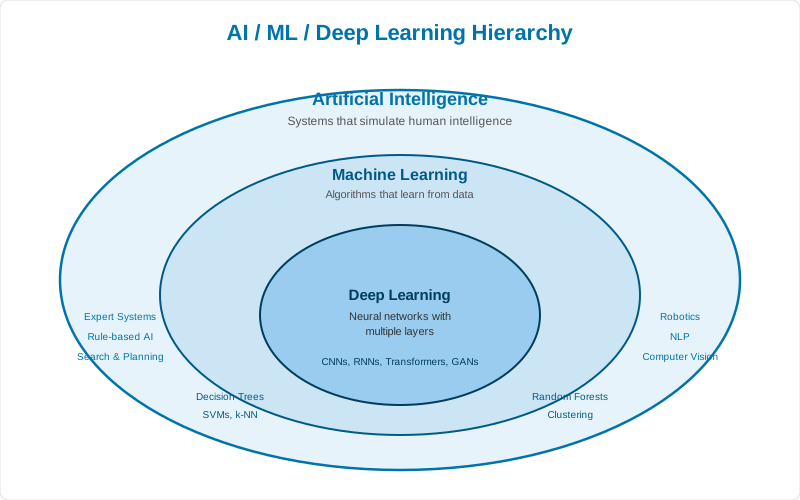
Figure 1: The relationship between AI, Machine Learning, and Deep Learning. Each field is a subset of the one above it.