Chapter 1: What is Computer Networking?
Computer networking is the practice of connecting two or more computing devices together to share data, resources, and services. From the moment you open a web browser to when you stream a video, send an email, or print a document wirelessly — networking is the invisible infrastructure making it all possible.
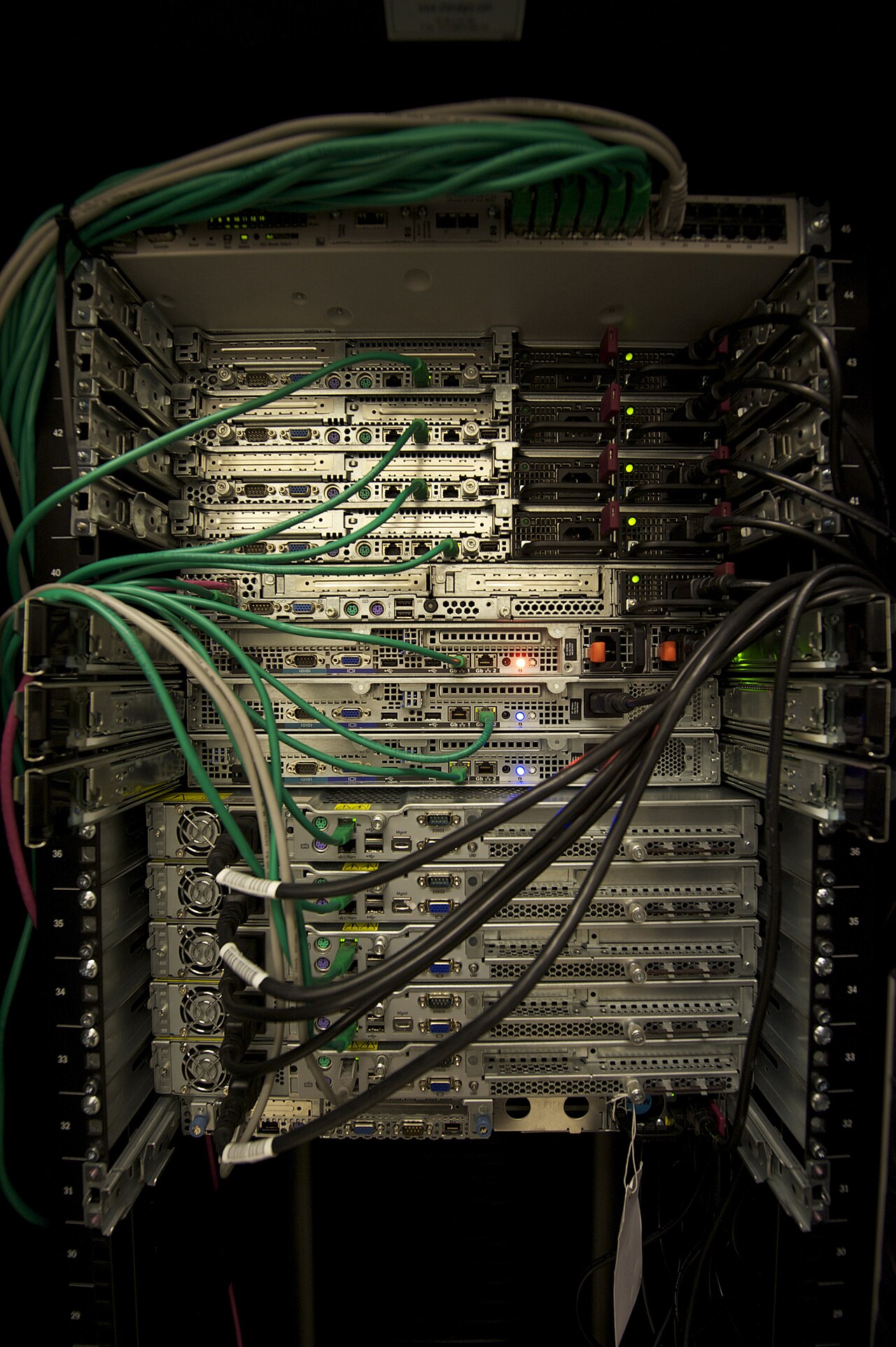
A server rack — the backbone of modern networking infrastructure — Photo: Wikimedia Commons (CC BY-SA)
Why Networking Matters
In today's hyperconnected world, networking is the backbone of virtually everything we do with technology:
- Communication — Email, instant messaging, video conferencing, and VoIP all rely on networks
- Resource Sharing — Printers, storage drives, and applications can be shared across a network
- Data Access — Cloud computing, databases, and file servers let users access data from anywhere
- Automation — IoT devices, smart homes, and industrial control systems all depend on networking
- Security — Firewalls, VPNs, and intrusion detection systems protect networks from threats
A Brief History
The story of networking begins in the late 1960s with ARPANET, a project funded by the U.S. Department of Defense's Advanced Research Projects Agency (ARPA). In 1969, the first message was sent between UCLA and Stanford Research Institute — the word "LOGIN" (though only "LO" transmitted before the system crashed).
Key milestones in networking history:
| Year | Milestone |
|---|---|
| 1969 | ARPANET established — first packet-switched network |
| 1974 | TCP/IP protocol suite proposed by Vint Cerf & Bob Kahn |
| 1983 | ARPANET switches to TCP/IP — the "birthday" of the Internet |
| 1989 | Tim Berners-Lee invents the World Wide Web at CERN |
| 1995 | Commercial Internet boom begins; Ethernet becomes dominant LAN technology |
| 1999 | Wi-Fi (802.11b) brings wireless networking to consumers |
| 2010s | Cloud computing, SDN, and IoT transform networking |
| 2020s | Wi-Fi 6/6E/7, 5G, and zero-trust networking become standard |
Types of Networks
Networks are classified by their geographic scope:
- PAN (Personal Area Network) — Bluetooth connections between your phone, watch, and earbuds (range: ~10 meters)
- LAN (Local Area Network) — Your home or office network connecting computers, printers, and servers (range: building-level)
- MAN (Metropolitan Area Network) — City-wide networks connecting multiple LANs, such as university campus networks
- WAN (Wide Area Network) — Networks spanning large geographic areas; the Internet is the largest WAN
- WLAN (Wireless LAN) — A LAN using wireless (Wi-Fi) instead of cables
Understanding these fundamentals sets the stage for everything we will cover in this tutorial. Whether you are setting up a home network or managing enterprise infrastructure, these concepts are your building blocks.